
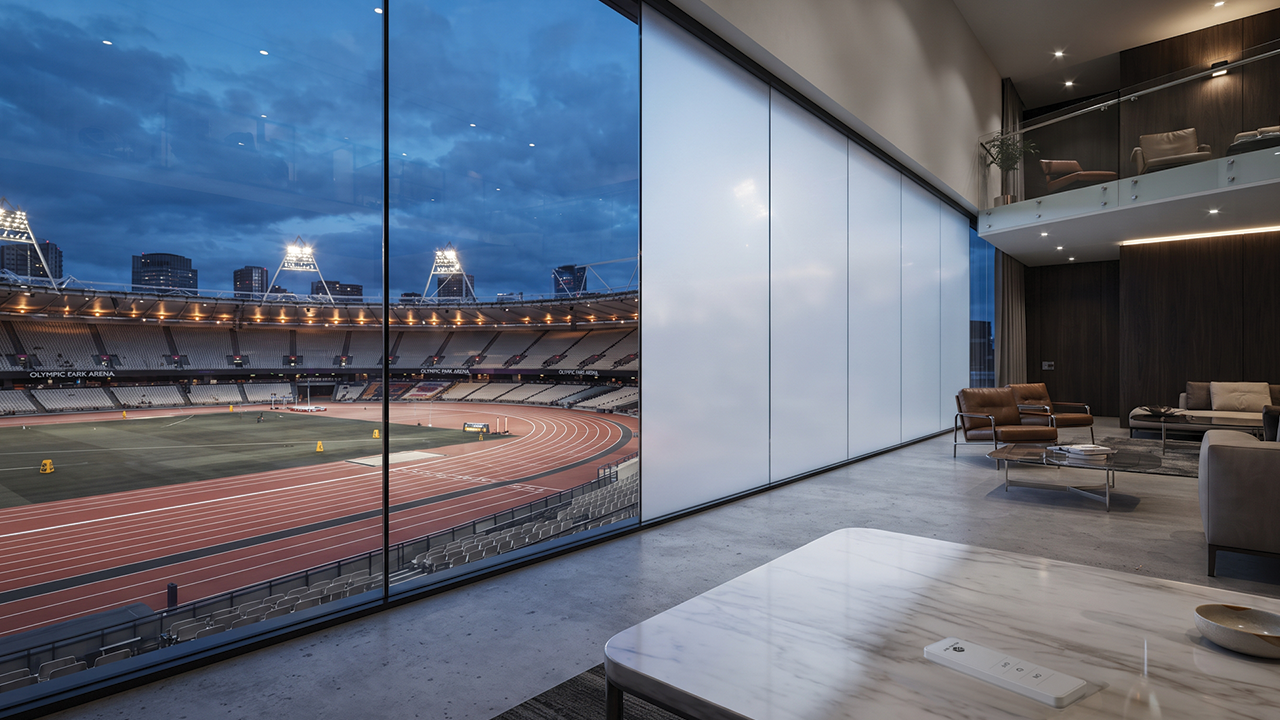
Think about the last time you were at a stadium. The noise, the energy, the experience. Now imagine if the very walls and windows around you could change from transparent to opaque in seconds, adapting to the sport, the moment, and the atmosphere.
That’s not science fiction. That’s PDLC film and switchable glass technology. And it’s quietly revolutionizing the way stadiums are designed, operated, and experienced.
The Problem With Traditional Stadiums
Most stadiums were built for one purpose. A cricket ground for cricket. A football pitch for football. A kabaddi arena for kabaddi. And while that made sense decades ago, the sports industry has changed dramatically.
Today, venues need to host multiple sports, accommodate thousands of fans with varying expectations, and do it all while keeping operating costs under control. That’s a tall order for a building that can’t adapt.
Here’s the reality:
- 70% of fans want a more interactive stadium experience (SportsTech Research)
- 60% more bookings are recorded at multi-sport facilities when adaptable spaces are available
- Traditional stadium infrastructure simply wasn’t built to meet these demands
So what’s the solution? Switchable glass technology specifically PDLC (Polymer Dispersed Liquid Crystal) film and switchable glass.
What Is PDLC Film and Switchable Glass?
Let’s break it down simply.
PDLC film is a smart material that can be applied to existing glass surfaces. When an electric current is applied, the liquid crystals inside the film align making the glass clear. When the current is switched off, the crystals scatter, turning the glass instantly opaque.
Switchable glass works on the same principle, but it’s built directly into the glass panels themselves, offering a more seamless and permanent solution for new constructions.
Think of it like a light switch but for your windows, partitions, and walls.
The result? Spaces that can change in seconds. Privacy when you need it. Openness when you don’t. And all of it controlled from a single interface.
Real Sports. Real Applications.
This isn’t just theory. Let’s look at how PDLC film and switchable glass are being put to work across different sports categories from football to cricket to kabaddi and more sports industry categories.
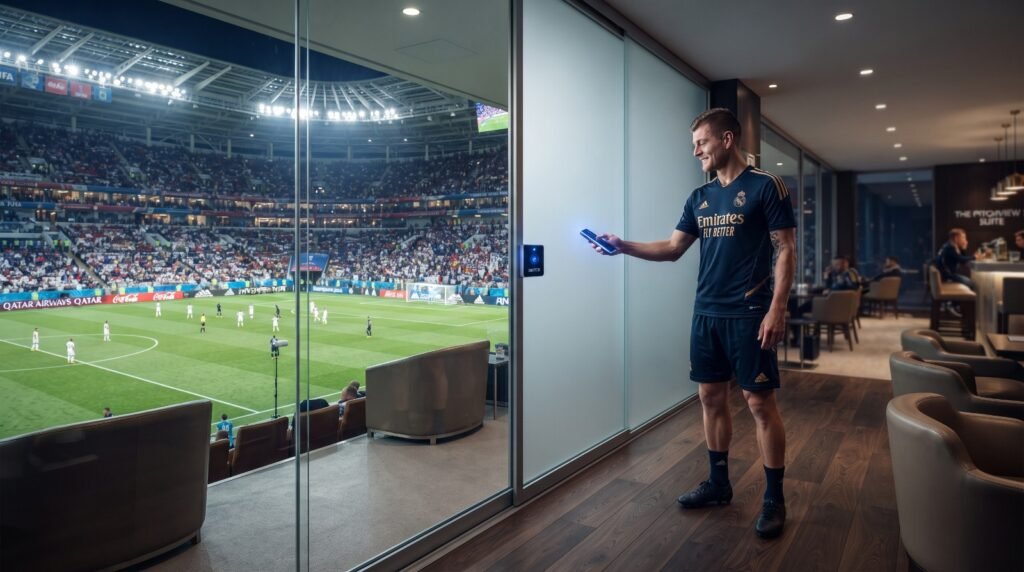
Men’s Football: Controlling the Crowd Experience
Men’s football stadiums are among the busiest, most complex venues in the world. They host not just matches, but pre-game press conferences, post-match interviews, VIP hospitality, and corporate events often on the same day.
With PDLC film installed on VIP suites and media rooms managers can:
- Instantly switch from transparent to opaque during sensitive press briefings or tactical team meetings
- Create immersive tunnel experiences where glass corridors transition from clear to frosted as players walk out building atmosphere and anticipation
- Segment hospitality areas without physical barriers, keeping sightlines open during the match and private during corporate functions
Imagine a glass-walled executive suite overlooking the pitch. During the match, its fully transparent fans get unobstructed views. During halftime, the glass frosts instantly, converting the suite into a private dining room. No curtains, no partitions, no fuss.
This kind of flexibility isn’t just impressive, it’s commercially smart. Venues that offer adaptable premium spaces can charge higher hospitality rates and attract a broader range of corporate clients.
Women’s Cricket: Blending Performance and Sustainability
Women’s cricket is growing fast. Attendance records are being broken. Broadcast audiences are surging. And the venues hosting these matches need to keep up.
Cricket stadiums face a unique challenge: matches last hours, sometimes days. That means players, officials, and fans are exposed to intense sunlight and heat for extended periods. Traditional solutions, awnings, tinted glass, and fixed shading are either too rigid or too costly to maintain.
Switchable glass offers a smarter path.
By integrating switchable glass into roofs, canopies, and player pavilions, cricket grounds can:
- Dynamically control glare and solar heat gain throughout the day, improving comfort for players and spectators alike
- Reduce energy consumption by up to 40% by minimizing the need for artificial cooling and lighting (Green Building Council)
- Protect players in dressing rooms and medical bays with instant privacy at the flick of a switch
- Enhance broadcast quality by reducing reflective glare on camera-facing glass panels
For women’s cricket specifically, where infrastructure investment is increasing rapidly, integrating switchable glass from the ground up signals a commitment to world-class facilities attracting top talent, broadcasters, and sponsors.
Men’s Kabaddi: Designing for Multi-Sport Flexibility
Kabaddi is one of the fastest-growing contact sports in the world. The Pro Kabaddi League in India alone draws tens of millions of viewers. But unlike football or cricket, kabaddi arenas often share space with other sports such as basketball, wrestling, volleyball, and more.
This is exactly where PDLC film proves its worth.
Multi-sport indoor arenas equipped with PDLC film can:
- Divide the arena floor into separate zones using frosted glass partition walls hosting two different sporting events or training sessions simultaneously without visual interference
- Create flexible coaching and analysis rooms with glass walls that switch from open and transparent during team briefings to fully private during tactical video reviews
- Enhance the fan experience with dynamic glass features at entry points, concourses, and viewing galleries creating visual moments that build brand identity and atmosphere
- Support broadcast and media operations by providing adaptable media rooms that can shift from open-access press areas to closed, controlled interview zones in seconds
For a sport like kabaddi where the atmosphere is electric and the action is fast every design decision should amplify the energy. Switchable glass doesn’t just serve a functional purpose. It becomes part of the experience.
Beyond Individual Sports: Stadium-Wide Applications
The applications of PDLC film and switchable glass extend well beyond specific sports. Here’s a broader look at how entire stadium infrastructures benefit:
Concourses and Fan Zones
Glass concourses are a staple of modern design. With PDLC film, these spaces become dynamic. Transparent during general admission hours, they can be partitioned into exclusive fan zones or branded activation areas for sponsors without any permanent construction.
Restaurants and Hospitality Suites
Restaurant glass walls that overlook the pitch can switch to opaque during private dining events, then return to transparent for match viewing giving operators maximum flexibility across a single day.
Training Facilities and Gyms
Athlete training areas often visible to fans in modern open-plan can use PDLC film to maintain privacy during sensitive training sessions, injury recovery protocols, or rehabilitation programs.
Event and Conference Spaces
Modern stadiums host far more than sport. Concerts, conferences, product launches, and community events fill the calendar. Switchable glass allows venues to convert their spaces rapidly and cost-effectively, maximizing revenue between sporting fixtures.
The Business Case: Why Stadium Operators Should Pay Attention
Let’s talk numbers.
The financial argument for switchable glass technology in stadiums is compelling:
- Energy savings: A 40% reduction in energy consumption translates to significant annual savings for venues with large glass footprints. Over a 10-year lifecycle, this can offset a substantial portion of the installation cost.
- Revenue uplift: With more adaptable hospitality and event spaces, venues can host more events per year and attract premium corporate clients.
- Reduced construction costs: PDLC film can be retrofitted onto existing glass, meaning stadium operators don’t need to replace entire glass installations just upgrade them.
- Extended venue lifespan: Adaptable venues are more commercially viable over the long term, reducing pressure on operators to undertake expensive structural renovations.
And with 60% more multi-sport facility bookings recorded at venues offering adaptable spaces, the demand is clearly there.
Sustainability: Building Stadiums That Last
The sports industry is under increasing pressure to reduce its environmental footprint. Fans care about sustainability. Sponsors care about it. Governing bodies are setting green targets.
Switchable glass technology directly supports these goals:
- Reduced lighting demand: Switchable glass that maximizes natural light ingress reduces the need for artificial lighting during daytime events.
- LEED and Green Star compatibility: Switchable glass contributes to green building certification points, a growing requirement for new developments globally.
For any stadium operator with sustainability commitments, PDLC film and switchable glass belong in the design brief.
What the Future Looks Like
The trajectory is clear. Stadiums are becoming smarter, more adaptable, and more connected. PDLC film and switchable glass are a foundational part of that evolution.
We’re already seeing:
- Fully automated glass systems that respond to lighting sensors, crowd density data, and event schedules without manual input
- Integration with stadium management platforms, allowing operators to control glass states across thousands of panels from a single dashboard
- Next-generation projection capabilities, where frosted switchable glass doubles as a projection surface for in-stadium content, advertising, and fan engagement displays
The future isn’t just a venue. It’s a responsive, intelligent environment and switchable glass is one of the key technologies making that possible.
The Takeaway
Whether it’s a packed football stadium on match day, a women’s cricket final under summer sun, or an indoor kabaddi arena buzzing with energy the common thread is this: the best venues are the ones that can adapt.
PDLC Film and Switchable Glass give stadium designers, operators, and sports organizations a powerful tool to create spaces that are flexible, sustainable, energy-efficient, and genuinely exciting for fans and athletes alike.
The technology is here. The demand is growing. Book your Royal Tint appointment today.